Whether you’re looking to make the high school team or compete at a more advanced club level, success in soccer depends on keeping pace with the game and matching up physically against the competition. That’s where soccer strength and conditioning training plays a key role for IMG Academy student-athletes in boarding school programs and camps.
This article breaks down what soccer strength and conditioning looks like at IMG Academy and how players can apply expert-backed principles to improve performance, whether training on campus in Bradenton, Florida or at home.
What Is Strength and Conditioning in Soccer?
Strength and conditioning is a structured training approach designed to improve an athlete’s physical abilities so they can perform at a higher level on the soccer field. Regardless of position—goalkeeper, defender, midfielder, or striker—a comprehensive program helps athletes stay healthy and effective through the final minutes of regulation and into double overtime.
For soccer players, strength and conditioning focuses on:
- Building total-body strength through full ranges of motion
- Developing agility and explosiveness, especially for goalkeepers
- Improving conditioning across all positions
- Reducing injury risk through age-appropriate exercises and movement patterns
Unlike general fitness training, soccer strength and conditioning is sport-specific, with exercises and drills selected to mirror the movements, speed, and physical demands of the game.
Benefits of Strength and Conditioning for Soccer Players
- Ability to maintain pace of play throughout the match
- Improved shooting, footwork, passing, defending, and overall movement
- Reduced risk of injury
- Support for long-term athletic development
Why Soccer Strength Training Matters for Young Athletes
Many young soccer players spend the majority of their training time with the ball—passing, shooting, and playing matches. While technical development is essential, focusing on skills alone can leave key physical qualities underdeveloped.
Without a balanced strength and conditioning plan, young athletes may:
- Fatigue late in games when intensity increases
- Lose explosiveness for sprints, jumps, and quick changes of direction
- Become more susceptible to common soccer-related injuries
- Plateau as the speed and physicality of competition increase
With a structured soccer strength and conditioning program, athletes can:
- Accelerate, decelerate, and change direction with greater control
- Build strength safely in an age-appropriate manner
- Improve stamina to maintain performance for a full 90 minutes and beyond
- Develop durable movement habits that support long-term athletic growth
At IMG Academy, strength and conditioning is not an optional add-on. It is a core component of developing powerful, resilient, and well-rounded soccer players.
When Should Soccer Players Start Strength and Conditioning?
Soccer players can begin forming strong strength and conditioning habits early in their athletic careers. At younger ages, training emphasizes proper movement patterns rather than heavy loading.
“If we’re looking at building up from our youngest athletes to our oldest athletes, we don’t expect our youngest athletes to be doing what our oldest athletes are doing,” said strength and conditioning coach Kinsey Propst.
Training for younger soccer players focuses on:
- Long-term athletic development
- Movement quality and footwork
- Age-appropriate progressions and resistance
- Developing good habits, including proper nutrition
What Does Strength and Conditioning Training Look Like at IMG Academy for Soccer Players?
Check out the video below to see inside IMG Academy’s strength and conditioning program:
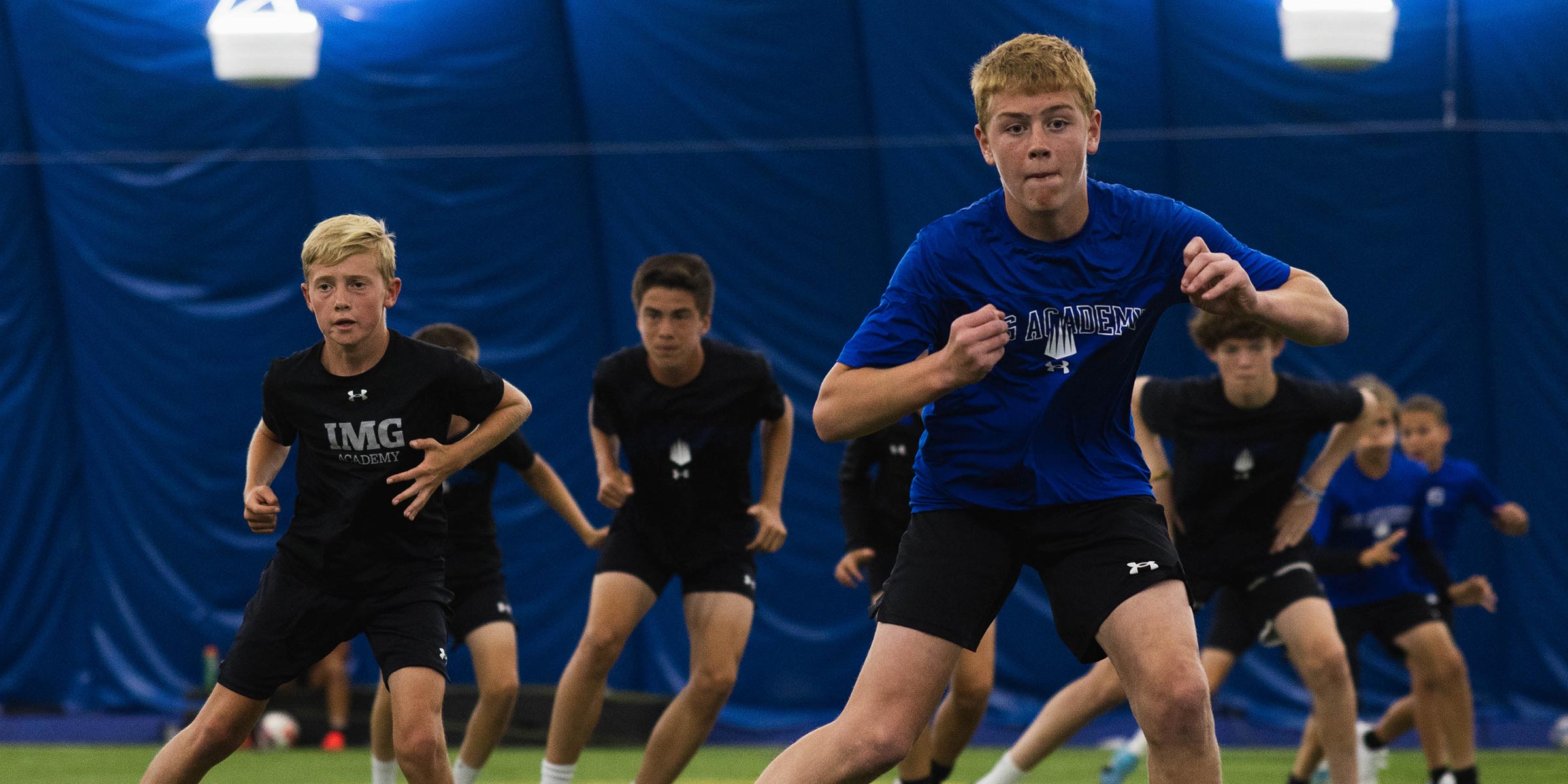
Soccer players in IMG Academy’s boarding school programs follow a strength and conditioning plan designed to support a 10-month competitive season. Athletes typically complete weight room sessions twice per week and begin on-field training with a dynamic warm-up.
What a Good Dynamic Warm-Up Looks Like for Soccer Players
- Sprints with varying speeds, distances, and directions, emphasizing deceleration and re-acceleration
- Lateral shuffles and crossover runs
- Diagonal cutting drills
- Backpedaling patterns
- Reactive jumping exercises
Unilateral and Hamstring-Focused Training to Balance Leg Strength
Common exercises include:
- Romanian deadlifts with dumbbells or barbells
- Single-leg and double-leg hamstring curls
- Nordic hamstring exercises
- Split squats for younger athletes and rear-foot elevated split squats for older athletes
- Single-leg squats to a bench or box
Posterior Chain and Hip Strength Development
Training emphasizes adequate adductor and abductor strength to support sprinting, cutting, and kicking mechanics.
Common exercises include:
- Banded clamshells, lateral walks, and monster walks
- Squat variations, including goblet squats for middle school athletes, front squats for freshmen and sophomores, and back squats for juniors and seniors
- Lunge variations such as forward, reverse, lateral, and cross-behind lunges
- Glute bridges and walkouts
- Seated groin squeezes and Copenhagen progressions and regressions
How Strength and Conditioning Improves Soccer Skills
Soccer is a sport built on repeated sprinting ability. Players must maintain speed, agility, and explosiveness for 90 minutes plus stoppage time, which requires a strong foundation of endurance and total-body strength across all positions.
IMG Academy’s Strength and Conditioning Programs Are Designed To:
- Strengthen muscles through all joint actions
- Improve speed, agility, and endurance for every position
- Reduce injury risk during long competitive seasons
How IMG Academy Prepares Soccer Players for the Next Level
Whether a player’s goal is competing in the NWSL, MLS, college soccer, or maintaining lifelong athletic health, IMG Academy provides a comprehensive development environment focused on long-term success.
“We follow a long-term athletic development model,” said Propst. “With fewer physical education classes and more early sport specialization, there has never been a greater need for athletes to be exposed to a comprehensive training program that develops movement patterns outside of their sport at a young age.”
Frequently Asked Questions About Soccer Strength and Conditioning
What is soccer strength and conditioning?
Soccer strength and conditioning is a training approach designed to improve the physical qualities soccer players rely on, including strength, speed, power, agility, endurance, and injury resistance, using drills that reflect the demands of the game.
At what age should a soccer player start strength training?
Most athletes can begin strength training in late elementary to middle school when programs are properly coached and focused on technique, coordination, and gradual progression.
How often should soccer players do strength and conditioning?
Frequency depends on age, season, and schedule, but many youth athletes benefit from two to three sessions per week in the off-season and one to two sessions per week during the season.
What strength training should soccer players do?
Soccer players should focus on lower-body strength, single-leg training, core stability, and basic upper-body movements such as squats, lunges, hip hinges, step-ups, planks, push-ups, and rows.
Why is strength training important for soccer players?
Strength training improves speed, power, and change-of-direction ability, helps players stay strong late in matches, and reduces injury risk by improving stability in the hips, knees, ankles, and core.
Train with IMG Academy
IMG Academy soccer camps are available year-round, including:
Each camp includes professional sports performance training designed specifically for soccer players. Learn how IMG Academy’s Soccer Strength and Conditioning programs can help you become stronger, faster, and more confident on the field.
Read more: Top drills to improve soccer skills