Football Training: Catching, Speed, and Conditioning
Football demands more than one athletic skill. A receiver needs reliable hands, but catching the ball means little if they can't create separation. A defensive back may have excellent speed, but they also need the conditioning to maintain their performance late in a game.
Whether you're preparing for your first varsity season or working toward the next level, effective football training should develop skills that work together.
Catching, speed, and conditioning are three important parts of that process. Each requires focused practice, but the real advantage comes from learning how to combine them without sacrificing technique or recovery.
The goal isn't to complete the hardest workout possible. It's to become a more complete football player who can execute consistently when the game gets faster, more physical, and more demanding.
Key Takeaways
Effective football training combines catching, speed, conditioning, and recovery to help players build skills that translate to game situations.
Improve catching with drills that focus on tracking the ball, securing passes, and making catches while moving.
Build football speed through short acceleration sprints, change-of-direction drills, and position-specific movements, with enough rest between repetitions.
Develop fourth-quarter conditioning with repeated efforts and recovery periods that reflect the demands of your position.
Structure training to prioritize speed and technique before demanding conditioning and track your progress to see what's improving.
Why Football Training Should Develop Multiple Skills
Football is a game of short, intense efforts separated by periods of recovery.
Players accelerate, stop, change direction, make contact, and react to opponents. Depending on their position, they may also catch passes, cover receivers, block, or pursue the ball.
Training only one quality can leave gaps in your performance.
A receiver who practices catching but neglects footwork may struggle to get open. A player who improves straight-line speed without developing stopping and cutting ability may have difficulty changing direction. An athlete who trains hard every day without sufficient recovery may struggle to perform consistently.
A balanced football training program addresses technical skills, physical preparation, and recovery.
That doesn't mean every practice needs to include everything. It means your overall plan should develop the abilities your position requires.
How to Catch a Football Better and More Consistently
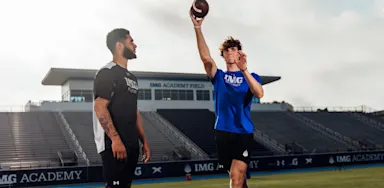
Reliable catching begins with tracking the ball and positioning your body to receive it.
Catching isn't simply about having strong hands. Your eyes, footwork, timing, and concentration all contribute to making a successful reception.
One of the most important skills is learning to watch the ball throughout its flight rather than turning your attention toward the defender or what you'll do after the catch.
Stationary Catching Drill
Begin with a partner standing a comfortable throwing distance away.
Have your partner throw passes toward different areas of your upper body. Focus on tracking each pass, presenting your hands appropriately, and securing the ball before resetting.
As you improve, vary the location and speed of the throws.
The goal is to build consistent catching mechanics before adding movement or defensive pressure.
Catching on the Move
Football players rarely receive every pass while standing still.
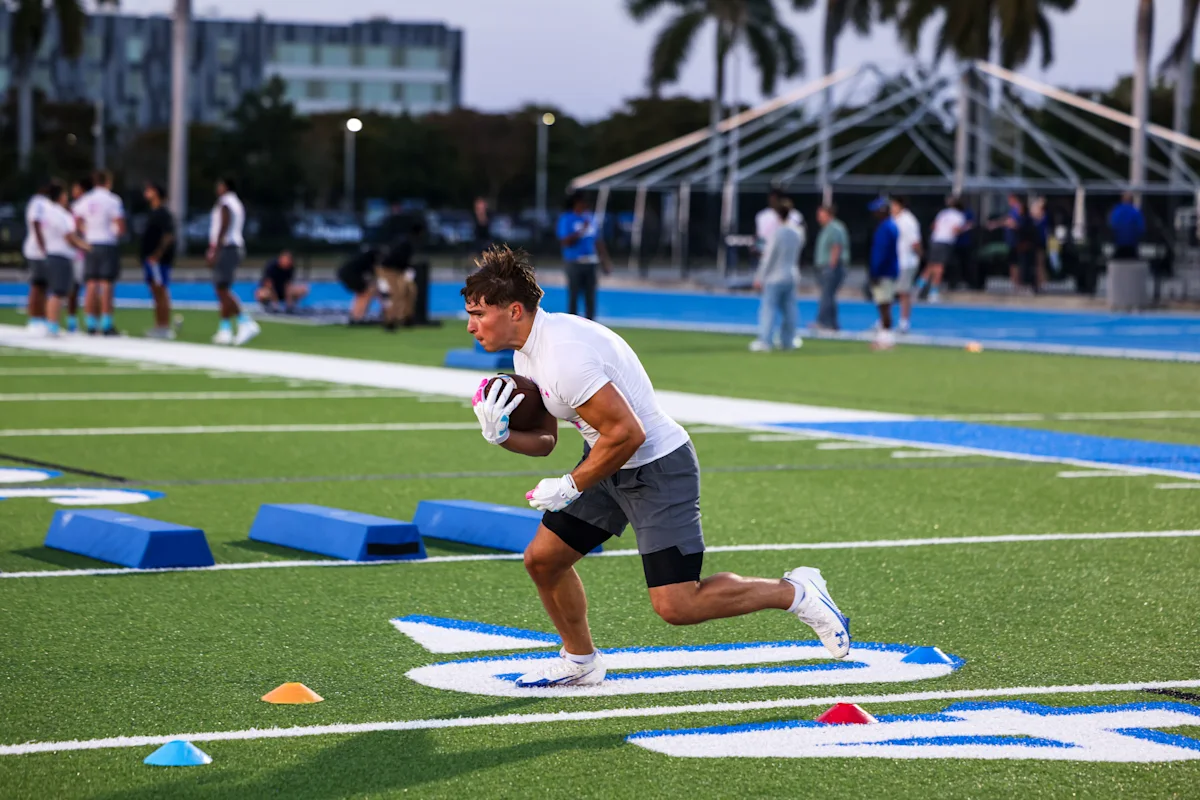
Set up two cones several yards apart and practice moving through the area while a partner throws the ball.
Begin at a controlled speed and gradually increase your movement as your timing improves.
Focus on keeping your eyes on the ball, adjusting your body position, and maintaining balance through the catch.
Avoid reaching for passes that are unsafe or beyond your ability to control.
High and Low Catching Drill
A quarterback won't deliver every pass directly to your chest.
Practice receiving passes above your shoulders and below your waist.
For higher passes, work on extending your hands and securing the ball before bringing it into a protected position.
For lower passes, adjust your body and hands to the ball's path while maintaining control.
The exact hand position will depend on the location and trajectory of the pass. Work with a coach to refine your technique.
Football Catching Drills That Build Game Skills
Once basic catching becomes consistent, drills should add more complex movement, timing, and decision-making.
Over-the-Shoulder Catch Drill
This drill helps receivers track passes while running downfield.
Begin with a partner throwing controlled passes over your shoulder as you move along a designated route.
Start at a manageable speed so you can locate the ball without losing balance.
As your tracking improves, increase the speed and vary the ball's placement.
Focus on maintaining your route while adjusting your eyes and hands to complete the catch.
Sideline Awareness Drill
Position cones to represent the sideline.
Run a short route toward the boundary and catch a pass while maintaining awareness of your position.
The objective is to secure the ball while practicing the footwork required to complete an inbounds catch under the rules that apply to your level of play.
Begin without a defender before adding controlled pressure.
Catch-and-Secure Drill
Some dropped passes happen because players begin turning upfield before completing the catch.
Practice catching the football, securing it against your body, and then accelerating toward a designated cone.
Separate the catch from the acceleration first. Once the sequence becomes reliable, make the movement more continuous.
View even more football drills from IMG Academy coaches.
Speed Training for Football Players
Football speed involves more than running a fast 40-yard dash.
Players must accelerate quickly, reach useful speeds over short distances, decelerate, and change direction in response to the play. Regardless of position, acceleration is always involved.
Effective football speed training should develop movement quality before adding unnecessary complexity.
"Speed is a skill, just like any skill," says Kevin Heiberger, MS, CSCS, Assistant Head of Strength and Conditioning in IMG Academy’s Athletic and Personal Development (APD) program. "It can be developed by athletes who are willing to be coached, and coaches who know how to teach it and have a system that yields highly predictable results."
Short Acceleration Drill
Set up cones approximately 5, 10, and 15 yards from your starting position.
After an appropriate warmup, accelerate through the designated distance while maintaining sound running mechanics.
Focus on producing a strong first step and building speed smoothly rather than immediately trying to run at maximum effort.
Take sufficient rest between repetitions, so you're practicing speed instead of simply becoming tired.
A coach can help determine the appropriate distances and repetitions for your age, experience, and training level.
Reaction Sprint Drill
Football players respond to visual information throughout the game. This drill connects reaction time with acceleration, but it should not replace football reads and decision-making.
Timing & Progression:
This type of work should be introduced during the pre-season, only after athletes have fully mastered change of direction mechanics.
How to Perform:
Begin in an athletic stance and have a partner provide a visual signal. React by accelerating toward a designated cone. Vary the timing of the signal, so you cannot anticipate exactly when to move.
Change-of-Direction Drill
Place three cones in a short line or triangle.
Move between them using the footwork and direction changes assigned by your coach.
Focus on slowing down under control before accelerating in a new direction.
Avoid turning every repetition into an all-out race. Efficient deceleration and balance are important parts of changing direction successfully.
How to Get Faster for Football
Track speed and football speed share important athletic qualities, but football adds opponents, equipment, and decision-making.
While a player may run quickly in a straight line, they can still struggle to accelerate from a football stance or change direction while reacting to a receiver. Developing an athlete to run faster in a general sense will always offer a transfer of training to their specific sport. Because of this, speed training must balance general athletic development with position-specific movement across different phases of the year.
The off-season is when general athletic development should occur. As you transition into the pre-season, the focus shifts toward "general-specific" methods and energy system development. For example, athletes can run various game-realistic route patterns in a random order to build position-specific capacities.
Additionally, the pre-season is the time to target specific strengths for speed development. This includes utilizing flying 20s to push top-end speed, which produces some of the highest-power outputs per step and executing sprints with sleds of varying weights. At this stage, traditional wall drills and technical exercises act only as secondary training tools, while power development becomes the primary focus.
A defensive back might practice transitioning from a backpedal into acceleration. A running back may work on planting and changing direction. A receiver may combine route running with acceleration after the catch.
For a demonstration of running-back footwork, watch IMG Academy’s football cone drill video.
Conditioning for Fourth-Quarter Performance
Conditioning helps football players sustain their ability to perform repeated efforts throughout practices and games.
Unlike distance running, football involves bursts of activity separated by rest periods.
That means conditioning should reflect the demands of your position and the structure of the sport.
A conditioning program might combine general aerobic development with carefully planned repeated-effort training.
The objective is to improve your ability to recover between plays without reducing the quality of your speed and technical work.
Repeated-Effort Conditioning Drill
Mark a short distance appropriate for your position and training level. After warming up, complete a controlled running effort followed by a planned recovery period. Repeat this cycle according to the program established by your strength and conditioning coach.
To make this drill truly sport-specific, the variables must mirror actual gameplay. "Football operates on a 1:3 work-to-rest ratio," notes Heiberger.At that ratio, 4 to 7 seconds of work pairs with 12 to 21 seconds of rest; the exact interval depends on the tempo of play.
While maintaining solid mechanics is important, athletes should not completely back off when tiredness sets in. Instead, the focus must shift to building resilience. As Heiberger emphasizes, "You want to stress the system to fatigue in order for the system to buffer for said stress."
Tempo Running
Tempo running involves controlled efforts below maximum sprinting intensity.
Depending on the training program, these runs can support general conditioning and provide an alternative to repeated all-out sprints.
Athletes should follow their coach's guidance on intensity and recovery rather than guessing how fast each repetition should be.
Tempo runs should be at 75 percent effort or below. Think long to short for conditioning. Longer times to shorter times.
For example, a coach might progress from 30-second efforts early in a conditioning phase to 15-second efforts later, adjusting rest and volume to the athlete.
Position-Specific Conditioning
Different positions have different physical demands.
For linemen, defensive line (DL) football drills should emphasize short, explosive efforts and position-specific technique.
Receivers and defensive backs may cover more ground at higher speeds, while linemen perform frequent short, explosive efforts involving contact.
Conditioning should account for those differences.
A well-designed program prepares athletes for the demands of their role instead of giving every player the same running workout.
How to Combine Catching, Speed, and Conditioning
The challenge isn't simply finding time for all three. It's organizing them so one type of training doesn't interfere unnecessarily with another.
Speed work generally benefits from being performed when you're relatively fresh. Catching techniques also require concentration and coordination.
Conditioning can create fatigue, which may make technical movements harder to execute correctly.
For that reason, it often makes sense to perform high-quality speed work before demanding conditioning within the same session.
Catching drills can be incorporated into technical practice or combined with controlled movement work.
Your schedule should also account for strength training, team practices, games, and recovery.
How to Structure Your Off-Season Football Training
The off-season offers an opportunity to improve skills that can be difficult to address during a busy competition schedule.
A balanced plan should develop athletic qualities progressively rather than attempting to maximize every training component immediately.
The following is an example of how training priorities could be organized, not a prescribed weekly workload.
Training focus | Primary objective | Example activity |
Catching | Improve tracking and ball security | Stationary and moving catches |
Acceleration | Improve first-step speed | Short acceleration drills |
Change of direction | Improve braking and reacceleration | Cone movement drills |
Conditioning | Support repeated football efforts | Coach-prescribed interval work |
Recovery | Support adaptation and readiness | Rest, sleep, and appropriate fueling |
The number of sessions should depend on your age, training history, other sports commitments, and recovery needs.
Younger athletes should prioritize developing sound movement patterns and a consistent training routine rather than copying an advanced college or professional program.
How to Measure Your Football Training Progress
Improvement should be measured by more than how tired you feel after a workout.
For catching, track the percentage of successful receptions under consistent conditions.
For speed, record short sprint times using the same distance and timing method.
For change of direction, evaluate both time and movement quality.
For conditioning, monitor whether you can maintain performance across repeated efforts and recover appropriately between them.
You can also compare practice film to identify changes in your movement or execution.
The most useful measurements are those that connect directly to what you're trying to improve.
Recovery Is Part of Football Training
Training creates the opportunity to improve. Recovery helps your body adapt.
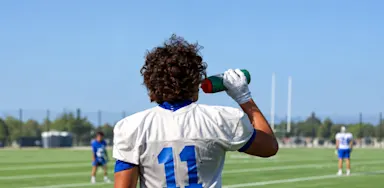
Support recovery with sufficient sleep and rest. Fuel and hydrate consistently to meet training and school demands.
Avoid stacking intense training sessions every day. Excessive training can increase fatigue and interfere with performance.
Watch for persistent soreness or unusual fatigue. Declining performance or discomfort that changes your movement also deserves attention.
Discuss these concerns with your coach. An athletic trainer or qualified health professional can help assess symptoms.
Recovery isn't time wasted. It's part of becoming a stronger and more consistent athlete.
For additional guidance on athlete development, the IMG Academy+ Essentials library includes football drills and resources covering areas such as nutrition and mental performance.
Build a More Complete Football Game
Becoming a better football player requires developing skills that support one another.
Reliable catching helps you finish plays. Speed creates opportunities. Conditioning supports your ability to execute repeatedly throughout competition.
But the real advantage comes from combining those qualities with good decision-making, consistent technique, and appropriate recovery.
Choose purposeful drills, monitor your progress, and work with your coaches to build a training plan that fits your position and stage of development.
Explore IMG Academy football camps for coached training or work with an IMG Academy+ Personal Coach on nutrition and mental performance.
Frequently Asked Questions
How do I train catching, speed, and conditioning without neglecting one?
Organize your training around clear priorities rather than trying to maximize every skill in every session. Practice catching consistently, complete speed work when you're relatively fresh, and schedule conditioning around other training demands. Your coach can help balance the workload.
Which drills build reliable hands under pressure?
Stationary catching, catching on the move, over-the-shoulder tracking, and catch-and-secure drills develop several aspects of receiving. Once you can perform them consistently, add appropriate movement, timing challenges, and controlled defensive pressure.
How do I get faster specifically for football, not just general speed?
Speed training is speed training; there is no such thing as “faster for football.” If you get faster in the 40-yard dash, you have the capacity to express that speed in a game. Game-day anxiety can interfere with how you express that speed. Uncertainty about your assignment can also slow your decisions and reactions. If you have already gone from conscious competent to unconscious competent with your sprint work, you will automatically run faster in the game.
How do I build conditioning that holds up in the fourth quarter?
Develop conditioning using training appropriate to football's repeated effort demands. Include adequate recovery, monitor performance across repetitions, and avoid relying only on exhausting workouts.
How do I structure an offseason training plan across all three?
Establish weekly priorities for catching, speed, conditioning, strength, and recovery. Adjust the schedule based on your age, training history, and team commitments. A qualified strength and conditioning coach can help individualize the plan.
How long before this kind of training shows up in games?
Consistent sprint work, such as two sessions per week across the year, can help sprint mechanics become automatic. Progress depends on your starting point, consistency, training quality, and recovery. Some technical improvements may appear quickly, while physical adaptations often take longer. Track measurable changes over several weeks and evaluate whether they transfer to practice and competition.