Basketball Training Skills Drills and Conditioning

Effective basketball training combines ball skills, strength, and the ability to move with control. A useful workout gives you time to handle the ball, shoot, pass, and practice footwork before adding conditioning that reflects the demands of a game. Start at a pace you can manage, then increase the challenge as your technique becomes more consistent.
Key Takeaways
Build basketball workouts around dribbling, shooting, passing, and footwork as well as physical conditioning.
Warm up gradually before practicing faster starts, controlled stops, and changes of direction.
Develop strength with exercises that match your experience and that you can perform with good form.
Add movement and decision-making to familiar drills to prepare for game situations.
Balance demanding sessions with recovery, and track specific skills to assess progress.
Basketball Training Quick Reference
Use these training areas to identify what your next session needs. You do not need to fit every exercise into every workout; choose a few that support your current goals.
Training Focus | Purpose | Practice Examples |
Ball control | Protect the ball while moving | Stationary dribbles, changes of pace |
Shooting and passing | Deliver the ball accurately | Close-range shots, target passing |
Footwork | Stay balanced when stopping and turning | Jump stops, pivots, defensive slides |
Conditioning | Repeat purposeful efforts | Short sprints, curved runs, recovery intervals |
Strength and mobility | Support controlled movement | Squats, lunges, rows, dynamic warm-ups |
Basketball Training Drills for Core Skills
Choose a clear objective for each drill, such as keeping your eyes up or stopping without losing balance. Begin slowly enough to recognize mistakes. Add speed, a partner, or a defensive cue once the movement is reliable.
Dribbling With Both Hands
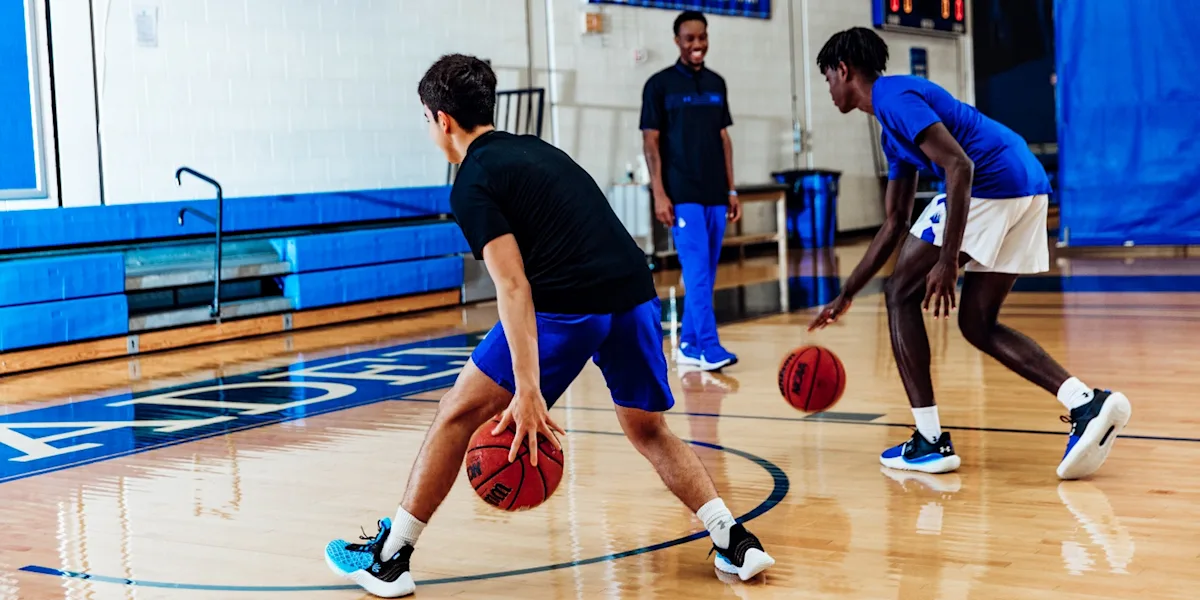
Start in an athletic stance and dribble at a controlled height with your right hand, then your left. Keep your eyes forward instead of following the ball. Next, dribble toward a cone, slow down under control, change hands, and accelerate away. Practice in both directions so your stronger hand does not do all the work.
Shooting After a Catch
Begin close to the basket with balanced feet and a comfortable release. Have a partner pass to you, or toss the ball to yourself, then catch, set your feet, and shoot. Once you can repeat your form, add a step into the catch from either side. Move farther away only while you can keep the same controlled motion.
Passing to a Target
With a partner, alternate chest passes and bounce passes aimed at a clear target. Step toward the receiver, finish your hands toward the target, and receive the return pass with ready hands. If practicing alone, use a suitable rebound wall in a clear space. Add a pivot before each pass to practice delivering the ball from different positions.
Stopping and Pivoting
Dribble forward, come to a balanced stop, and establish your pivot foot before turning toward an imaginary teammate. Repeat in both directions while keeping the pivot foot planted. This connects ball control with the footwork you need to pass or protect possession.
Moving in a Defensive Stance
Set two markers a few steps apart. Slide between them with your hips lowered and your feet under control, then stop without letting your momentum carry you past the marker. Add a partner who points to the next direction to introduce a reaction challenge. IMG Academy's guide to cone drills and agility training offers more ways to practice acceleration and changes of direction.
Conditioning for Game Movement
Basketball conditioning should develop acceleration, deceleration, and the ability to repeat efforts. Players need to jump, land, and change directions while staying in control. For younger or less experienced athletes, movement quality comes before more demanding speed or power work.
As IMG Academy's Director of Strength and Conditioning for basketball, I help athletes combine physical preparation with on-court skill work. Coaches can then reinforce ball control and movement technique as players build toward game speed.
Begin with a dynamic warm-up that includes easy movement, skips, controlled lunges, and lateral steps. Progress from easy runs to faster efforts after you feel ready. Use recovery time between repetitions so each effort remains purposeful.
Dribble and accelerate: Run a short distance while controlling the ball, then slow down deliberately before turning back.
Curved runs: Follow the arc of the three-point line to practice moving on a curved path as well as in a straight line.
Hops and landings: Practice small, controlled hops and land softly in a balanced position before progressing to more demanding jumps.
Defensive slides: Move laterally, stop under control, and push off into the next direction.
Experienced athletes may use resisted sprints or platform landing drills with a qualified coach. These are progressions, not requirements for a beginner's session.
Once you know which skill needs attention, the basketball drills in IMG Academy+ Essentials can provide demonstrations to support your practice between coached sessions.
Strength Exercises for Basketball
Basketball strength and conditioning should reflect your training experience, schedule, and movement quality. A qualified strength coach can help you select loads and learn technique before increasing the difficulty. The goal is to build capacity for the court without leaving you too fatigued to practice well.
Useful basketball exercises include the following movement patterns:
Trap-bar deadlifts train the hips and legs while challenging trunk control and grip.
Front squats develop lower-body strength and require control through the hips, ankles, and upper body.
Single-leg squats and lunges challenge balance and strength on one side at a time.
Overhead presses and lat pulldowns train vertical pushing and pulling.
Chest presses and rows train horizontal pushing and pulling.
IMG Academy's guide to strength and conditioning for student-athletes explains how strength work fits into an athlete's broader development.
Training Without a Weight Room
Push-ups, bodyweight squats, and lunges can form the basis of a simple session at home. Use a variation you can control through a comfortable range of motion. A slower lowering phase or brief pause can make an exercise more challenging without adding weight. Keep your breathing steady, and finish the set before your form deteriorates.
Consistent training also depends on how you prepare and recover. If fueling a busy practice schedule or maintaining focus is a challenge, IMG Academy+ Personal Coach offers individualized nutrition or mental performance coaching to support those habits.
Managing Training Load and Recovery
You cannot eliminate every injury risk, but you can make training more manageable by building up gradually and allowing recovery. Pay attention to persistent pain, fatigue, and changes in your movement instead of pushing through a declining session.
Increase gradually: After time away, return with a workload you can control before adding more intensity or playing time.
Vary the impact: When your legs need a break from running and jumping, a coach may use a bike for lower-impact conditioning.
Maintain mobility and strength: Practice controlled movements through a comfortable range, and make recovery part of the weekly plan.
For demonstrations that complement this approach, explore IMG Academy's injury prevention and recovery exercises for basketball.
Putting a Workout Together
A practical session can move from a dynamic warm-up to a small group of skill drills, followed by a short conditioning block and an easy cool-down. Keep skill learning early enough that you can concentrate. Later, practice familiar skills with purposeful movement to introduce some of the demands of competition.
Record one or two measures, such as successful passes to a target, makes from the same shooting spots, or controlled dribbles with your non-dominant hand. Compare similar sessions rather than judging progress from a single good or bad day. The guide to effective goal setting for athletes can help turn those observations into a clear practice objective.
Frequently Asked Questions
How do I structure a workout that covers skills and conditioning?
Start with a dynamic warm-up, practice a few specific skills, and finish with a manageable conditioning block. You can also combine familiar skills with movement, such as dribbling through a short acceleration and controlled stop.
Which drills translate to better play in games?
Drills that connect technique with movement and decisions are useful preparation. Add a catch before a shot, a pivot before a pass, or a partner's cue before a change of direction once you can perform the basic skill consistently.
How do I train by myself with a ball and a hoop?
Combine stationary and moving dribbles with close-range shots and self-toss catch-and-shoot repetitions. Once your form is steady, add brief movement before a set of shots, then recover before fatigue changes your technique.
How do I build game shape?
Practice short accelerations, controlled stops, lateral movements, and repeated efforts with recovery between them. Progress the workload gradually and include ball skills so conditioning stays connected to the way you play.
How do I know whether training is working?
Look for repeatable improvements in the skills you track and in your ability to use them during practice or games. Better control, more accurate passes, and steadier technique late in a session are useful signs alongside your shooting results.
Build Your Next Basketball Workout
Productive basketball training gives skills, strength, conditioning, and recovery a clear role. Pick a few priorities, practice them consistently, and increase the challenge as your control improves. IMG Academy+ Essentials can support that plan with basketball demonstrations and broader performance resources, helping you make the most of the work you do between team practices.