Speed and Agility Training for Young Athletes
Believe it or not, speed is trainable. And for young athletes, results come from quality movement, not volume. Research on youth plyometric training shows real gains in sprinting, jumping and change-of-direction speed when the work is structured well.
Sprinting builds top-end speed. Explosive exercises build power. Change-of-direction work builds control. Recovery lets each session count.
The rest of this guide breaks down what speed and agility actually mean for a young athlete, and what exercises can help build these crucial skills.
Key Takeaways
Speed and agility training can improve qualities such as acceleration, sprinting, power and change-of-direction ability.
Speed includes acceleration and top-end speed, while agility involves reacting and adjusting your movement.
Effective training for speed and agility prioritizes fast, technically sound repetitions and appropriate recovery.
Plyometric exercises can help develop the explosive power needed for sprinting and quick changes of direction.
Recovery gives your body time to adapt and helps you perform high-intensity training at full capacity.
Can Speed Really Be Trained?
Yes. "Speed is like any other skill, right?” said Will Townsley, Director of Strength and Conditioning at IMG Academy. “We can improve it through intentional training on the field/track/diamond and supplement it with weight room work.” Structured training can improve many of the physical qualities behind faster movement.
Sprinting helps you practice accelerating and reaching higher speeds.
Plyometrics can develop explosive power.
Change-of-direction work teaches you to brake, reposition and accelerate again.
There’s research to back this up. For example, a review of multiple studies of plyometric training found that youth athletes who trained twice a week saw improvements in their sprinting, jumping and change-of-direction abilities.
But doing the work isn’t the same as doing it well. Training quality matters a lot when it comes to increasing your speed and agility. When every session becomes a race to see how tired you can get, movement quality suffers. Focus on making each repetition controlled and technically sound, even if it means sacrificing a little bit of speed.
You can think of it like practicing a skill: You would not rush through hundreds of shots to improve your accuracy. You would focus on quality repetitions. Training for speed and agility follows the same principle.
Speed vs. Agility: What's the Difference?
Speed and agility are related, but they require different abilities. Speed is your ability to move quickly. That includes acceleration, or how quickly you can reach a higher speed, along with your ability to maintain speed once you get moving. Agility involves reacting and adjusting your movement. In a game this looks like planting your foot, cutting around an opponent and accelerating into open space. The distinction between speed and agility is why a fast straight-line runner is not automatically the most agile athlete.
Building a Speed and Agility Program
A good youth speed and agility training program should balance sprinting drills, change-of-direction work, explosive exercises and recovery.
Acceleration and Sprint Work
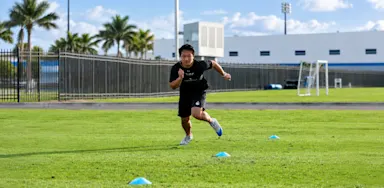
Start with short sprints that give you enough distance to practice accelerating without turning the session into conditioning.
Begin by getting into an effective starting position with your hips low, in either a square or staggered stance. Pick a spot five to 10 yards straight in front of you.
Run toward the target and touch the ground with both hands when you reach it. Don’t try to take too long of a stride as you run. Focus on taking short, efficient steps. As you reach down to touch the ground, keep your chin and chest up, dropping your hips.
After you reach the target, backpedal to your starting position and touch the ground with both hands.
Run forward again. This time, run through the target.
This linear acceleration drill gives you a chance to practice accelerating and decelerating effectively.
Give yourself enough recovery between repetitions to maintain speed. If your sprint starts looking like a tired conditioning run, the session has moved away from its primary purpose.
Agility and Change-of-Direction Drills
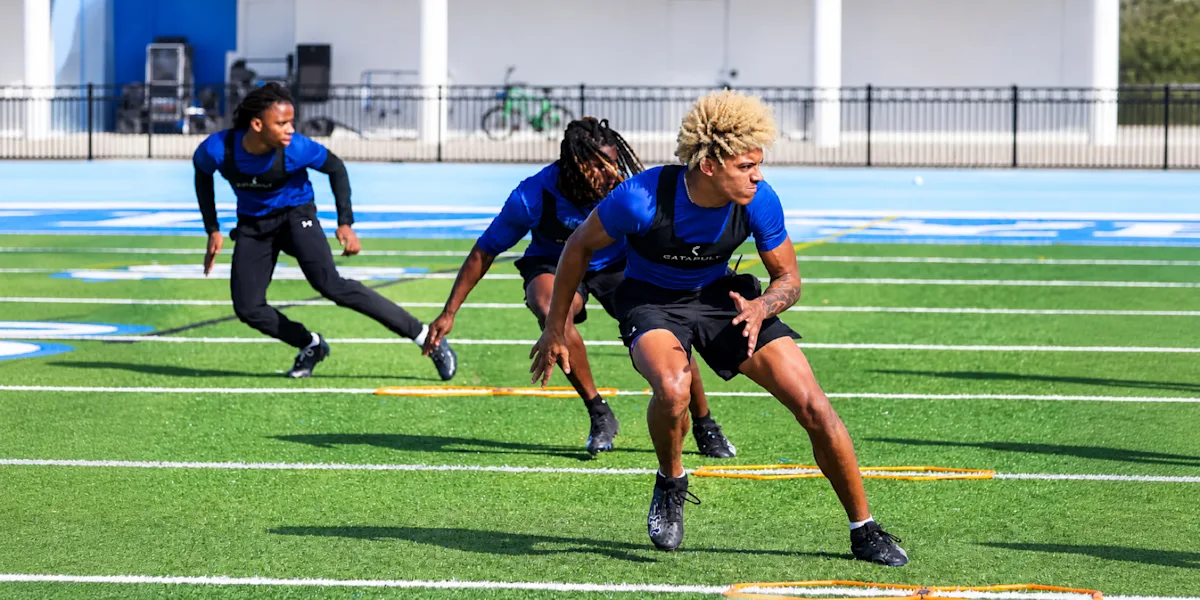
Cone drills teach you how to plant, brake and change direction so you have faster reaction times during competition.
The drills in the video and below give you a controlled way to build agile movements and develop muscle memory over time:
U Drill
Place two cones in a line, five to ten yards apart.
Touch the first cone, then backpedal until you reach the second cone behind you.
Curve around it in a U shape, plant, and sprint forward to touch the first cone again.
Backpedal back to the second cone and repeat.
Lateral Weave
Set three cones in a line, about five yards apart.
Starting at one end, shuffle laterally past each cone, touching down and changing direction as you pass it.
Face the same direction throughout so the movement stays lateral instead of turning into a straight run.
This mirrors the side-to-side footwork athletes use to track an opponent or the ball.
Square Drill
Arrange four cones in a five-yard square.
Sprint the first side, then laterally shuffle the second.
Backpedal the third side.
Finish by laterally shuffling the fourth side, which will bring you back to the start.
Stay facing one direction for the full lap so the focus stays on the transitions between movement types.
As you’re practicing these drills, focus on the quality of each cut. Lower your center of mass when appropriate, control your deceleration and push into your next movement instead of simply racing through the pattern. Keep your feet below your hips and avoid cross-stepping.
Plyometrics for Explosiveness
Plyometrics use quick jumps and other explosive movements to train your ability to produce force rapidly. That quality matters when you are trying to accelerate or quickly change direction.
Examples of plyometric exercises include squat jumps, broad jumps, and lateral bounds. Keep the number of jumps manageable so you can maintain good form with each repetition.
For youth athletes, allow adequate recovery between demanding sessions. Avoid stacking high-intensity jump work on consecutive days unless a qualified coach has designed the program that way.
Training Safely and How Fast to Expect Results
Getting faster is a training process, and your body needs time to adapt.
Research suggests that athletes can see measurable gains after one to three months of structured speed and agility training. However, your exact results will depend on factors such as your age, training history and program design.
Give high-intensity speed work adequate recovery and avoid adding more sessions simply because you think it will get you faster results. Remember, your rest and recovery habits are part of the training process. Consistent sleep and good nutrition help you return to your next session ready to perform.
How IMG Academy Develops Speed and Agility
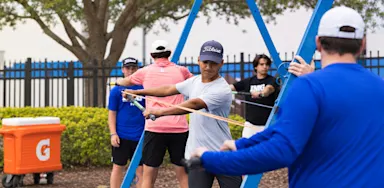
IMG Academy brings speed and agility work into a broader training program, designed for student-athletes. “Any coach can make an athlete tired, but not every coach can make an athlete faster,” said Kevin Heiberger, assistant head of strength and conditioning at IMG Academy. “But you can make an athlete faster as long as you have an athlete that is willing to be coached and that has a system in place like we do at IMG Academy.”
Athletes can train at IMG Academy performance camps designed to improve strength and speed or boarding school on our campus in Bradenton, Florida. Athletes anywhere in the world can use IMG Academy+ Essentials to access self-guided training content.
Through our developmental coaching programs, athletes build physical and mental fortitude that supports long-term success in and out of sport.
The payoff comes when those gains show up on game day: when you beat an opponent to the ball, out-juke a defensive tackle, or are the first one to cross the finish line.
Conclusion: Get Faster the Right Way
Speed and agility training can help young athletes become faster, more explosive and more adaptable under pressure. However, adding more drills to your week does not automatically lead to better results.
Prioritize quality sprint work. Practice controlled changes of direction. Add age-appropriate plyometrics. Give your body time to recover. Then repeat that process consistently.
A productive speed session should leave you with quality work behind you, not simply a feeling of exhaustion. Focus on training with purpose.
IMG Academy+ Essentials and IMG Academy+ Personal Coach can help you with speed, agility and so much more, so you can achieve your athletic dreams.
Frequently Asked Questions
Can Speed Actually Be Trained or Is It Mostly Genetic?
Both genetics and training influence speed. Genetics affect characteristics such as body structure and muscle composition, but training can improve acceleration, sprint mechanics and change-of-direction ability. Research involving young athletes has found improvements in sprinting and other performance measures after structured plyometric and speed-focused programs. Your starting point matters, but consistent training can help you become a faster athlete.
What's the Difference Between Training Speed and Training Agility?
Speed is your ability to move quickly, including how fast you accelerate and how quickly you can cover ground. Agility involves adjusting your movement in response to what is happening around you. In competition, that can mean slowing down, changing direction and accelerating again because an opponent or teammate changed the play.
Effective training for speed and agility should address both qualities so you can develop straight-line speed and the ability to react during competition.
How Often Should I Train Speed Without Overtraining or Getting Hurt?
There is no single schedule that works for every athlete. Training frequency should account for your age, sport, current training load and experience. Work with a qualified coach to determine how much high-intensity training fits into your overall week and make sure to leave enough recovery between demanding sessions.
Do the Ladders and Cones Actually Transfer to Game Speed?
They can, but the equipment itself does not guarantee better game speed. Cones can help you practice acceleration, braking and changes of direction. Ladders can challenge coordination and footwork. The transfer becomes more meaningful when drills require movements that resemble your sport. For example, a football player might place cones in a pattern that mimics how the defensive line typically blocks them when they’re about to run with the ball.
How Long Before I See Real Improvement in How Fast I Play?
You may notice changes within several weeks, but there is no universal timeline. Some research has found improvements after programs lasting four to 12 weeks. But your results will depend on your starting level, training consistency, recovery and the quality of the program. Focus on steady progress, not instant results.
What's the Biggest Mistake People Make Trying to Get Faster?
One common mistake is confusing fatigue with effective speed training. When every drill becomes a conditioning challenge, you may perform repetitions while tired rather than practicing high-quality, explosive movement. Speed work should give you opportunities to move quickly with good technique. Consistent, high-quality work will give you more to build on than simply finishing every session exhausted.